The argument has become a fixture of online debate. The Quran affirms the Torah and the Gospel as revelation from God. Those scriptures contradict the Quran on the crucifixion, the divinity of Jesus and much else. So either the scriptures are reliable, in which case the Quran is wrong, or they are corrupt, in which case the Quran was wrong to affirm them. Christian debaters call this “the Islamic Dilemma” and present it as a closed trap. It deserves a close reading, because its force depends on two premises that the Quran does not supply.
Premise one: that the Injīl is the New Testament
The Quran speaks of the Tawrāt (the Torah), given to Moses, and the Injīl (the Gospel, from the Greek euangelion), given to Jesus. The grammar is consistent throughout. The Injīl is something God gave to Jesus.
The four canonical Gospels are a different kind of document. They are narratives about Jesus, written in Greek by later authors, and they bear the names that church tradition attached to them. Much of their content consists of what others said and did around Jesus, including accounts of his death that the Quran denies.
The dilemma therefore needs an equation the Quran never makes: the Injīl of the Quran equals the four Gospels of the later Christian canon. Once that equation is dropped, the first horn loses its object. The Quran affirms a revelation given to a prophet. The critic supplies a library compiled by his followers and assigns the affirmation to it.
Premise two: that 5:43 and 5:47 certify an intact text
The verses most often cited are these two. The first concerns Jews of Medina who brought a legal case to the Prophet.
The verse makes a specific claim: the Torah held in Medina contained God’s judgment on the matter in dispute. Ṣaḥīḥ al-Bukhārī preserves the case itself. A Jewish man and woman had committed adultery. The Prophet asked what the Torah prescribed. The men who brought the case said public shaming and flogging, and when the scroll was opened, one of them covered the verse of stoning with his hand.
The report cuts both ways against the dilemma. God’s ruling was present in the text, which is exactly what 5:43 asserts. And the custodians of the text were concealing it, which is exactly what the Quran elsewhere calls taḥrīf (distortion). The Hebrew Bible does prescribe death for adultery, so the ruling survived. The episode describes a scripture that retained divine content while its holders obscured it.
Sūrat al-Māʾidah 5:47 follows the same logic. It tells the people of the Injīl to judge by what God revealed in it. An instruction to judge by what God revealed in a book presupposes that divine content remains recoverable. It makes no claim that every sentence in the book is divine.
The same chapter records the distortion
The critic’s reading of 5:43 and 5:47 has to set aside a verse thirty verses earlier in the same chapter.
Two charges sit side by side here. Words were moved from their proper places, and a portion of the original message was forgotten. Sūrat al-Baqarah 2:79 condemns those who write a book with their own hands and then say it is from God. Sūrat Āl ʿImrān 3:78 describes a party who twist their tongues with the scripture so that listeners take their words for scripture.
Classical exegetes debated whether this alteration touched the wording, the meaning, or both. None of them read 5:47 as a certificate of textual perfection, because the text of al-Māʾidah itself forbids that reading. The dilemma gets its contradiction by quoting half of one chapter against the other half.
| Verse | What it says | What it establishes |
|---|---|---|
| 5:13 | The people of the covenant “distort words from their places” and have forgotten a portion of what they were reminded of | Alteration and loss |
| 5:43 | The Torah held in Medina contains “the judgment of God” | Divine content survives |
| 5:46 | God gave Jesus the Injīl, confirming the Torah before it | The Injīl is a revelation given to Jesus |
| 5:47 | The people of the Injīl are to judge by what God revealed in it | Divine content remains recoverable |
| 5:48 | The Quran confirms the earlier scripture and is muhaymin (guardian) over it | The Quran is the criterion |
Muhaymin: the Quran’s own model
The Quran states its relationship to earlier scripture in one word, in the verse that immediately follows 5:47.
Muhaymin (guardian, overseer, the one who stands witness over something) carries the sense of an authority that checks and verifies. A guardian over a text confirms what in it is sound and identifies what is not. The verse pairs taṣdīq (confirmation) with haymanah (oversight), and the pairing only makes sense if the earlier text contains both.
This is the position the dilemma leaves out. Its two horns are total reliability and total corruption. The Quran asserts a third position: earlier revelation survives in the scriptures of the Jews and Christians, mixed with human additions and losses, and the final revelation is the criterion by which the two are told apart.
Sūrat Yūnus 10:94, which tells the Prophet to ask those who read the scripture before him if he is in doubt, fits the same model. A witness asked about the pattern of prophecy must retain knowledge of it. The verse says nothing about the textual condition of what the witness reads.
What the Bible’s own record shows
The Quranic account of partial alteration matches what the Bible and its textual critics report. The prophet Jeremiah rebuked those who claimed to possess the law of the Lord, and said that the false pen of the scribes had made it into a lie (Jeremiah 8:8). That is a biblical prophet accusing scribes of corrupting scripture within the Bible’s own pages.
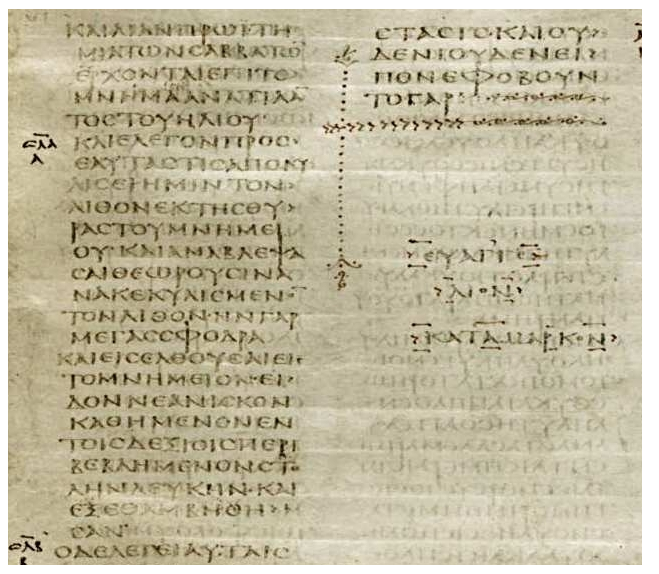
The New Testament shows the same process in its manuscripts. The last twelve verses of Mark (16:9 to 20) are absent from the two oldest complete Greek manuscripts, Codex Sinaiticus and Codex Vaticanus, and many modern translations bracket them or flag them in a note. Christian textual scholarship reconstructs an earlier text precisely because the transmitted text grew over time. The Quran described that process in the seventh century.
Revelation 22:18 and the closed canon
A related argument holds that the Bible forbids any later revelation, citing the warning at the end of the book of Revelation against anyone who adds to its words (Revelation 22:18 to 19). The warning concerns “the words of the prophecy of this book,” the Apocalypse of John.
Deuteronomy carries the same warning in almost identical terms: do not add to the word I command you, and do not take from it (Deuteronomy 4:2; 12:32). Christians accept that Joshua, the Psalms, the Prophets and the entire New Testament came after that warning without violating it. The same reasoning applies to Revelation. Its place as the last book of a bound Bible is an arrangement made by later compilers; its author could not have been sealing a collection that did not yet exist as one volume.
Does 15:9 promise to preserve the earlier scriptures?
A related argument uses the Quran’s promise of preservation against it. The verse reads:
The word rendered “Qur’an” in this translation is al-dhikr, “the reminder.” Critics observe that the Quran also uses dhikr for earlier revelation, as when it tells its audience to ask “the people of the reminder” (16:43), and conclude that 15:9 promises to preserve the Torah and the Gospel as well. If so, those books could not have been altered.
The context of the verse settles its reference. Three verses earlier, the Prophet’s opponents mock him with the same word:
“The one upon whom the dhikr has been sent down” is Muhammad, and the dhikr is the revelation sent down to him. The promise in 15:9 answers that mockery: the reminder they ridicule is the one God will guard. A word that can refer to several revelations takes its reference from its context, and here the context points to one revelation only. The Quran says elsewhere that the guardianship of earlier scriptures was entrusted to their own communities (5:44), which is why their preservation could fail where the Quran’s would not.
What remains of the dilemma
The argument needs the Quran to say two things. It needs the Injīl to be the four Gospels, and it needs 5:43 to 5:47 to certify a complete and unaltered text. The Quran says neither. It describes a revelation given to Jesus, a scripture that still carried divine rulings in Medina, a record of distortion and forgetting in the same chapter, and a final revelation appointed as guardian over the whole.
That position is internally consistent, and it is the position the historical evidence supports. The dilemma presents two options because it has removed the third, and the third is the one the Quran holds.