You are familiar with the idea that the universe is large. Thirteen-point-eight billion years old. Ninety-three billion light years across. Hundreds of billions of galaxies, each with hundreds of billions of stars. The scale is meant to suggest insignificance: that any talk of purpose or design in such a cosmos is human vanity projected onto an indifferent void.
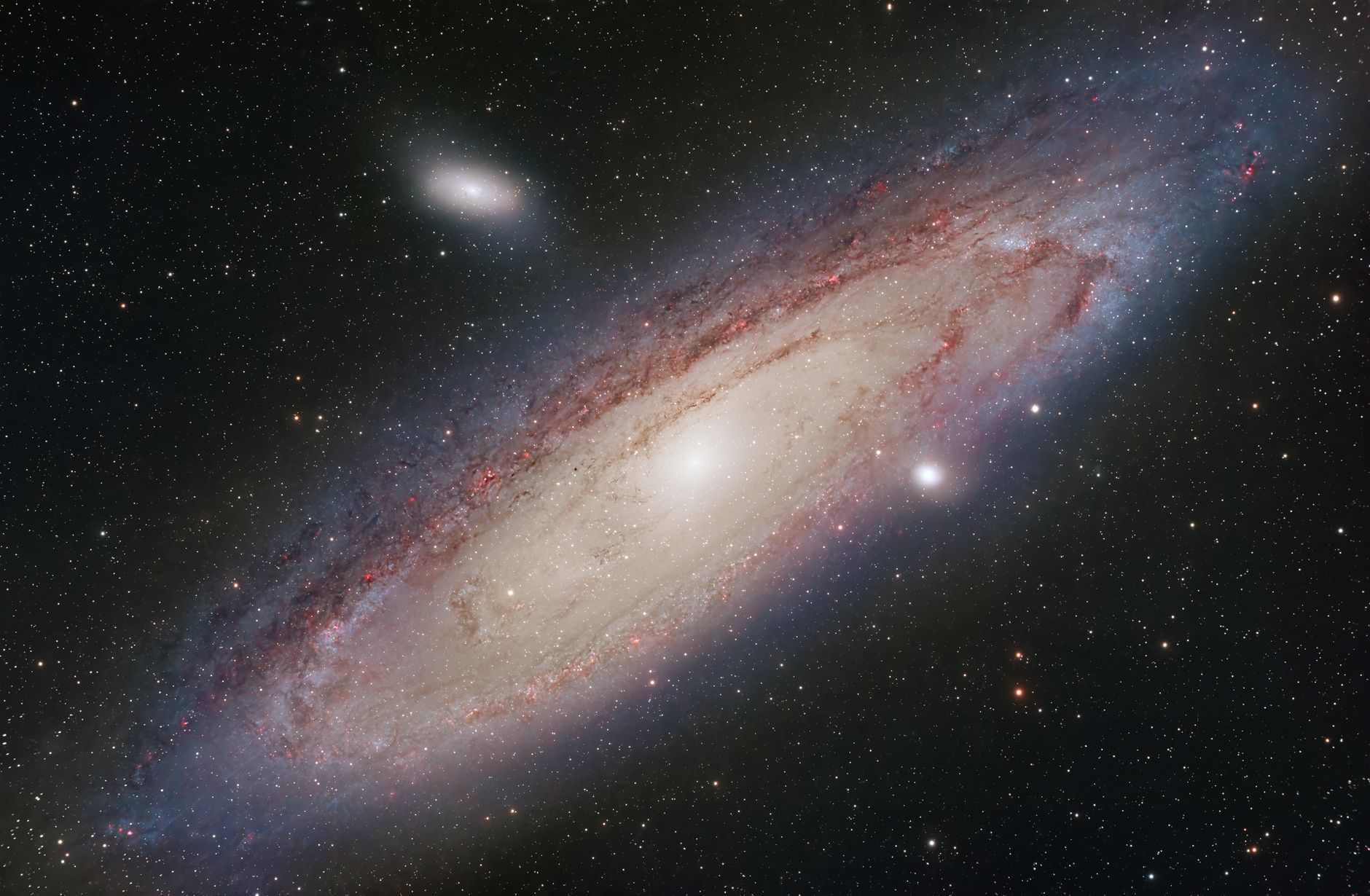
Here is something the scale argument misses. The universe is not merely large. The universe is absurdly specific. The physical constants that govern its behaviour are set to values so precisely calibrated for the existence of chemistry, stars, planets, and life that physicists, including physicists with no interest in theology, have been unable to simply move past the observation.
What the constants are
The universe operates according to forces: gravity, electromagnetism, the strong nuclear force, the weak nuclear force. Each of these forces has a strength, described by a number. The cosmological constant governs the rate at which the universe expands. The ratio of electromagnetic force to gravitational force determines whether stars can form and sustain nuclear fusion. The mass of the electron relative to the proton determines whether chemistry is possible. These numbers are what they are. Physics currently has no explanation for why they have the values they have.
The question is: what would happen if they were different?
The answer
The answer has been studied extensively, and it is striking. If gravity were slightly stronger, stars would burn out too quickly for life to develop. If it were slightly weaker, matter would not clump into stars and planets at all. If the cosmological constant were slightly larger, the universe would have expanded too rapidly for any structure to form. If it were slightly smaller, the universe would have collapsed back on itself before life could arise.
An astrophysicist who spent his career as a committed atheist, an architect of the theory of stellar nucleosynthesis, examined the precision required for carbon to form inside stars and wrote that the universe looked like “a put-up job.” He did not become a theist. He could not dismiss the observation.
A physicist calculated the probability of the universe beginning in its current low-entropy state, the condition required for the ordered physical processes that permit life, at one in ten to the power of ten to the power of one hundred and twenty-three. The number does not fit comfortably inside normal intuitions about probability. The number of atoms in the observable universe is approximately ten to the power of eighty.
The Quran’s challenge to look
The Quran, addressing the same kind of observation in a pre-modern register, issues a direct challenge:
The verse does not assert design as an article of faith. The verse instructs the reader to perform an empirical test: examine the structure of the heavens for any evidence of disorder or breakdown. The challenge presupposes that the structure will withstand the examination. Modern cosmology, in identifying the precision of the physical constants, has performed exactly the kind of looking the verse calls for. The observation has not produced evidence of disorder. The observation has produced evidence of specification at every level scientists have learned to measure.

The standard responses
Two responses to the fine-tuning argument are commonly offered. The first is the anthropic principle: we observe these constants because if they were different, we would not be here to observe them. The principle is true and does not explain anything. The fact that survivors of a firing squad are alive does not explain why they survived. The firing squad still needs explanation.
The second response is the multiverse: if sufficiently many universes exist with different constants, one of them will by chance have life-permitting values, and that is the one in which observers will find themselves. The response has the structure of an explanation but faces serious difficulties. There is currently no empirical evidence for any other universe. The multiverse itself requires fine-tuning; the mechanism that generates multiple universes must itself be carefully specified. The multiverse is also not a scientific theory in the conventional sense, since it makes no testable predictions that could in principle be falsified.
Signs in the horizons and within yourselves
The Quran proposes a second observational test, this one paired with an explicit prediction:
The verse uses two technical Arabic terms. Al-āfāq (the horizons) refers to the outer cosmos, what modern physics studies through cosmology and astrophysics. Al-anfus (within themselves) refers to the inner constitution of the human creature, what biology, neuroscience, and the study of consciousness investigate. The verse’s claim is that as understanding of both deepens, the structure visible in each will increasingly disclose its origin. The fine-tuning argument is one such disclosure. The argument from consciousness, addressed elsewhere on this site, is another.
What fine-tuning establishes
The fine-tuning argument does not prove that God set the constants. The argument establishes that the life-permitting nature of the universe requires an explanation, and that the available naturalistic explanations are either evidentially unsupported or themselves require the kind of prior specification they were meant to explain.
Design, a cosmos set up with the production of conscious life in mind, is one of the live options that serious physicists and philosophers consider. The resistance to it is often philosophical rather than evidential: a prior commitment to naturalism that rules out the design hypothesis before the evidence is examined.
When the options are laid out plainly, the structure becomes hard to avoid. Either the constants are as they are by sheer chance, by physical necessity, by virtue of a multiverse of which ours is one, or by design. Chance requires accepting a probability so vanishingly small that physicists compare it to a blindfolded archer hitting a target the size of a single atom on the far side of the observable universe and getting it right on the first shot.
Necessity has no scientific support; we have no theory that predicts these constants must have the values they have. The multiverse shifts the problem rather than solving it: whatever process generates the universes requires its own precise specification, and the fine-tuning question simply moves up one level. Design is the only option that treats the specificity of the constants as something genuinely requiring explanation, rather than something to be explained away by multiplying hypothetical universes we can never observe.
The person who insists that design must be ruled out has not followed the argument to its conclusion. They have decided in advance which conclusions are permitted, which is the appearance of reasoning rather than reasoning. Follow the evidence honestly, and the question is not whether fine-tuning is evidence for design. The question is whether the evidence is strong enough to warrant the conclusion. The numbers are not subtle.
Where this fits
The fine-tuning of the universe is a datum. A very specific, very striking datum. It sits alongside the cosmological argument, the consciousness argument, and the moral argument as part of a cumulative case that, taken together, points in a consistent direction.
The case here does not end with vague spirituality. It points toward a Creator whose unity makes sense of the order of the world, the reliability of reason, and the moral seriousness of human life. The Quran’s invitation to look again at the structure of creation is fulfilled, on the modern reading, by the precise scientific work that fine-tuning research represents. The verse anticipates the test. The data, when gathered, returns the result the verse predicted: no rifts visible to any examination yet performed.