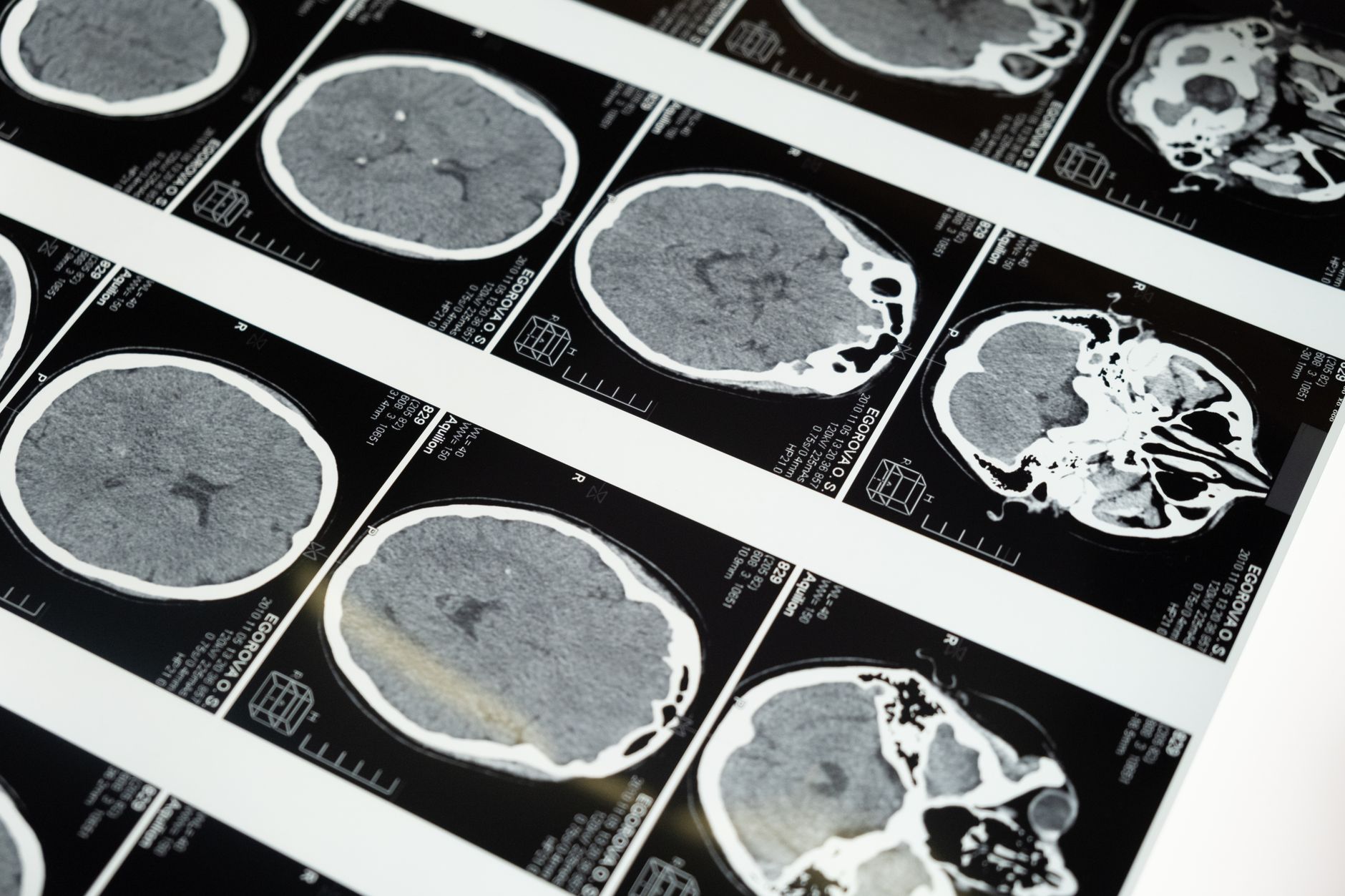
Stimulation of specific brain regions can produce experiences that subjects describe in religious terms: a sense of presence, of light, of contact with something vast and personal. Michael Persinger’s “God helmet” used weak magnetic field stimulation to induce such feelings in laboratory subjects. Near-death experiences correlate strongly with specific neurological events. The evidence that religious experience is associated with brain states is real. The question is what this evidence actually establishes.
The inference problem
The argument from neuroscience to the unreality of religious experience makes an inference the evidence does not support. The finding that religious experiences correlate with brain states does not establish that those experiences have no external referent, that they are only brain events with nothing beyond them.
All experience correlates with brain states. Visual perception of a real chair involves neural activity in the visual cortex. Love involves oxytocin release and activity in the prefrontal cortex and limbic system. Perception of another person’s face involves the fusiform face area. The fact that an experience has a neural correlate says nothing about whether the experience corresponds to something real. If the brain is the instrument through which a conscious being engages with reality, we would expect all genuine contact with reality to involve brain states, including genuine contact with God.
Persinger’s work and its limits
Michael Persinger’s God helmet experiments, widely cited as demonstrating that religious experiences can be produced artificially, have a significant problem: independent replication has largely failed. A Swedish team led by Pehr Granqvist found that the experiences Persinger’s subjects reported correlated more strongly with their prior suggestibility and expectation than with the actual magnetic stimulation. When subjects did not know which condition they were in, the effects largely disappeared. Persinger’s original findings remain in the literature, but their interpretation as evidence that God-experiences are neurological artifacts is considerably weaker than its popular reception suggests.
The quality of religious experience
A further consideration is the character of serious religious experience as reported by those who have had it. Mystical traditions across Islam, Christianity, Judaism, and Hinduism converge on a phenomenology that is markedly different from hallucination or suggestion: the experience tends to be self-authenticating in a way that ordinary experience is not, carries epistemic force that persists long after the experience has ended, and is typically accompanied by moral transformation rather than merely pleasant sensation.
In the Islamic tradition, the category of kashf (spiritual unveiling) is treated with careful epistemological caution. It is not taken as self-sufficient evidence for theological conclusions. The tradition has always situated such experiences within the framework of revelation rather than as replacements for it. This is epistemically responsible: personal experience, however compelling, requires external criteria against which it can be assessed.
The Quranic framing of inward signs
Islam’s account of signs includes inward experience as one mode of divine disclosure (rather than the only mode, and not self-sufficient, but real). The fact that these inward experiences involve the brain is not a problem for the Islamic account. Of course they involve the brain. The question is whether the brain, in its experience of what it registers as transcendent, is tracking something real. Neuroscience, as currently practised, does not have the tools to answer that question. It can describe the instrument. It cannot determine whether the instrument is in contact with what it appears to be in contact with.
The symmetry argument
If neuroscience can be used to argue against religious experience, consistency requires applying the same argument to the experiences through which scientific knowledge is obtained. All scientific observation is mediated by sensory and cognitive apparatus that is itself a product of evolutionary processes with no inherent guarantee of producing true beliefs about reality. The neuroscientific debunking argument, if it works against religious experience, threatens to work against all experience, including the experience of doing neuroscience.
The observation is a reminder that the question of whether any experience tracks reality cannot be settled simply by pointing to the brain processes involved in having the experience, rather than a counsel of despair. The philosophical question about the reliability of experience is prior to the neuroscientific question about its mechanisms.

The Prophet on the heart and recognition
The Islamic tradition has a refined vocabulary for the inner faculty by which the human creature recognises God. The Prophet ﷺ identified the heart as the organ of this recognition:
The hadith locates the centre of moral and spiritual perception in the heart, conceived as the seat of intention, attention, and orientation rather than merely the physical organ. The Islamic account of religious experience does not require that experience to be brain-independent; it requires that the brain (and the heart in the Quranic-anthropological sense) be the proper instrument through which the human creature engages with realities that are themselves real. Neuroscience describes the instrument. The Islamic tradition describes what the instrument is for. The two accounts are complementary rather than competing, once the philosophical confusion in the debunking argument has been removed.
What this leaves
Neuroscience has documented that religious experience involves the brain. That documentation establishes nothing about the reality of what the experience is of. The same documentation, applied consistently, would establish nothing about the reality of what scientific observation is of, or what moral perception is of, or what mathematical insight is of. The instrument of human knowing is the brain. Every act of knowing involves it.
The question of whether the instrument is in contact with reality is the philosophical question, and that question is not settled by mapping the instrument’s mechanisms. The Islamic framework holds that genuine religious experience tracks something real, that the brain is the proper instrument for that tracking, and that the inward signs the Quran describes are accessible to those who attend to them carefully. Neuroscience has not refuted this. Neuroscience has, in mapping the instrument, given a richer description of how the tracking actually works.